

Multi-platform
Access our systems on any operating system, browser, and device.
Intelligent Powered by ATHENA, ProDIGIQ AI
Automate critical processes and surface risks before they escalate.

Configurable
Tailor the system to meet your unique organizational needs.
THERA Details
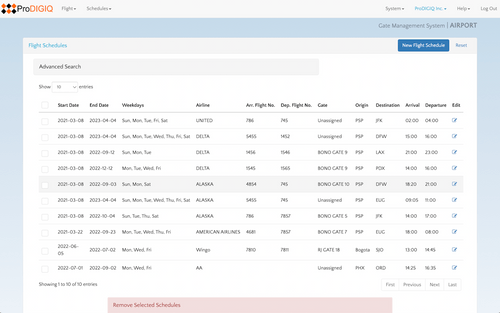
ProDIGIQ’s Gate Management System, THERA, is a robust and intuitive system for gate assignment, management, and optimization at airports. THERA enables airports to define prevailing operational requirements, including scheduling constraints, adjacency rules, and gate utilization preferences. Airports can upload and edit flight schedules in XLS and SSIM formats, as well as grant airlines system access to upload their respective flight schedules. Airports can use THERA to simulate gate assignment scenarios to establish a schedule that maximizes gate utilization and profitability. THERA includes visual cues and alerts that allow airports to proactively manage gate overlap and adjacency rule violations. THERA supports forecasting and planning with its repository of historical data and extensive reporting capability. THERA alleviates congestion at airports by minimizing the time aircrafts spend taxiing on the runway. This also reduces jet fuel usage which provides airlines with substantial cost savings and allows the airport to become more eco-friendly. THERA is a scalable and configurable solution to meet the evolving needs of the airport as it expands and transforms its operation.
System Overview
Define hard constraints including physical dimensions of gates and federal requirements for international flights
Articulate time and space adjacency rules such as buffer between flights, allowed aircraft equipment, and space constraints for adjacent gates
Optimize gate usage with preferential gate for signatory carriers, airline-specific preferences, and common-use gate assignments
Integrate with real-time flight data feed to optimize gate usage and proactively make adjustments based on last-minute flight changes
Key Benefits
Automatic gate assignments based on preferences and rules
Simulation of gate assignment scenarios before publishing
Temporary system access for airlines to upload flight schedules
Optimized gate utilization for efficiency and increased profitability
Scalable and configurable solution to meet airport's evolving needs
Enhance communication between airport and airlines regarding gate assignments and any changes, especially on day of operations
Improve passenger experience by reducing time spent on the tarmac waiting for a gate
Provide airlines with cost savings by minimizing the time aircraft spends waiting for a gate
Detect potential issues in real-time by monitoring aircraft scheduling and delays
Allocate resources effectively by proactively identifying conflicts and reporting discrepancies
Additional Subject Information
Airports are constantly growing, whether it be a terminal expansion, increase in passenger traffic, or addition of new routes and airlines. Efficient gate management is integral to optimizing and streamlining operations amidst constant growth and change. Optimal gate assignment must consider gate availability, dynamic flight schedules, airport traffic constraints, airline preferences, and passenger experience. Factors such as whether the incoming flight is scheduled or irregular operation, domestic or international, and signatory or non-signatory are also considered by airports when defining rules for gate assignment. Although these factors pertain to most airports, each airport may consider other factors and define business rules that are unique to their airline agreements and flight operations. Gate management systems are a powerful tool to efficiently manage gate assignment and maximize gate utilization. While some airports have digital solutions in place, many airports still rely on a manual process for gate allocation which is prone to error.
Gate management software can automate this complex and time-consuming process by generating robust gate assignments based on pre-defined business rules. A gate management system can be scalable and configurable to accommodate the shifting demands of the airport and the industry at large.
Signs That an Airport Needs Gate Management System
Manual process for gate allocation that is time and labor intensive
Difficult and inefficient process for making revisions to schedule
Poor communication of changed gate assignments and discrepancies
Challenges with monitoring gate availability and utilization
Long wait times for aircrafts upon landing on tarmac
Challenges in monitoring real-time flight schedules of inbound and outbound aircraft