

Multi-platform
Access our systems on any operating system, browser, and device.
Intelligent Powered by ATHENA, ProDIGIQ AI
Automate critical processes and surface risks before they escalate.

Configurable
Tailor the system to meet your unique organizational needs.
FAA Part 139 Airport Self-Inspection Module Details
ProDIGIQ's FAA Part 139 Airport Self-Inspection Module automates the daily self-inspections for safety and FAA compliance. The Part 139 Self-Inspection Software is custom-designed to fit the needs of each airport. ProDIGIQ's Part 139 Self-Inspection software replaces manual record-keeping with an intuitive and integrated digital solution.
The Part 139 Inspection Software allows for data to be input via mobile devices directly on the airfield in real-time. Part 139 Inspections are archived with all required info and available instantly. Discrepancies automatically generate work orders that are immediately sent to key personnel. All discrepancies are carried over to subsequent Part 139 inspections until closed. Increase safety with automated record keeping and closed-loop accountability ensure FAA Part 139 compliance.
System Overview
Continuous FAA 139 Compliance guaranteed with updates to inspection forms as needed
Mark airfield map with discrepancies and attach photos for easy follow-up
Advanced search capability based on variety of parameters
Optional GIS integration allows for monitoring of issues related to specific assets
Built-in work order module automates maintenance process to resolve discrepancies
Key Benefits
Reduce costs by automating operational processes and record keeping
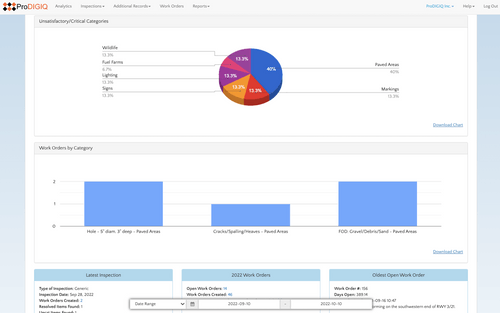
Perform benchmarking and trend analysis using dashboard analytics
Receive alerts for overdue inspections and automatic email notification of inspections and work orders
Improve safety and FAA compliance with closed-loop accountability and real-time communication
Seamlessly procure solution through GSA Schedule
Additional Subject Information
According to the Federal Aviation Administration (FAA), AC 150/5200-18D Section 3.2 Released on 9/18/2019, "Inspection Personnel can be most effective in performing inspections when they have clear instructions, checklists, and access to informational resources." This is exactly the reason why the FAA has provided documentation to outline the requirements of Airport Self-Inspections.
This guidance includes classifications of airports, what those specific classifications must inspect, and checklists of items to be examined and later delivered to FAA Administrators in the event of an Airport Inspection. With this guidance, airports have the tools to develop a self-inspection process that fits their specific organization's processes and ensures compliance with the FAA.
Qualifications for a Part 139 Airport
Serve scheduled and unscheduled air carrier aircraft with more than 30 seats
Serve scheduled air carrier operations in aircraft with more than 9 seats but less than 31 seats
Airport agrees to certain operational and safety standards and provides firefighting and rescue equipment. *Note: Part 139 does not apply to airports at which air carrier passenger operations are conducted only because the airport has been designated as an alternate airport
Signs That an Airport Needs Self Inspection System
Airport lacks the tools to make proactive data-driven decisions
Unable to efficiently extract meaningful data from submitted inspections
Difficulty tracking information/work order completion progress to close the loop on P139 discrepancies
Inefficient process leads to duplicate work orders being created for the same discrepancy
Time consuming process to prepare documentation for annual FAA inspections